
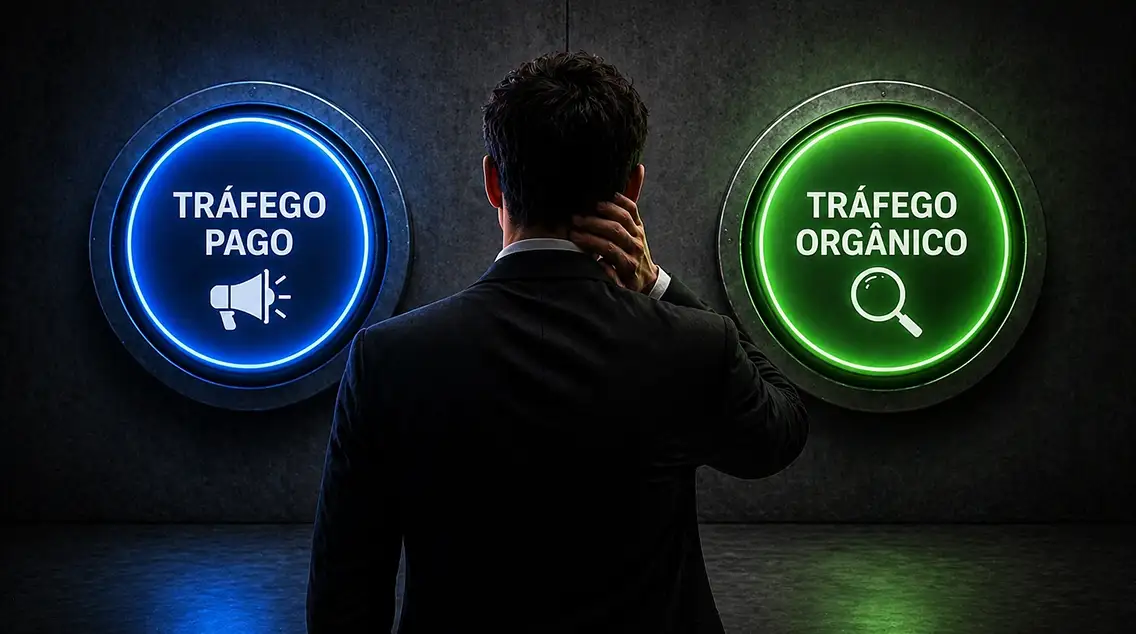
Choosing between paid vs organic traffic is the mistake that most stalls digital growth for companies. This isn't an "either/or" decision. It's a structure decision.
If you're comparing paid vs organic traffic as if they were isolated alternatives, you've already started wrong. The problem isn't the channel. It's how you view growth.
The question isn't which traffic to choose, but rather: do you have a structure capable of turning any traffic into predictable results?
Index
Key Insight:
Traffic doesn't generate results. Structure does. Traffic only amplifies what already exists.
What is paid and organic traffic
Before comparing, you need to understand the role of each one.
Paid traffic is every visitor that arrives at your website through ads. You pay to appear. This includes platforms like Google Ads and social media.
Organic traffic comes naturally, mainly through SEO. That is, when your site appears in search results without paying per click.
If you want to go deeper, it's worth understanding the concept of SEO in our article about what is SEO and also how ads work in what is paid traffic.
Attention:
The common mistake is thinking one replaces the other. It doesn't. They fulfill different roles within the same system.
The problem of choosing only one
Companies that choose between paid vs organic traffic are usually trying to save money or simplify something that is structurally complex.
And that comes at a price.
When you bet only on paid traffic:
- Fast results
- Constant dependence on investment
- Increasing cost over time
When you bet only on organic traffic:
- Sustainable growth
- Takes time to generate results
- Lack of short-term predictability
Now comes the critical point.
When you don't have structure behind it, any traffic that comes in doesn't convert. And when it doesn't convert, you start blaming the channel.
But the problem was never the channel.
Why companies fail when investing in traffic
Most companies don't have a traffic problem. They have an architecture problem.
They do this:
- Create campaigns without strategy
- Produce content without conversion intent
- Have an institutional website that doesn't sell
The result is predictable
Traffic comes in and goes out.
When the website isn't designed to convert, the visitor doesn't find clarity, doesn't understand the value, and doesn't take action. Media investment becomes an expense. SEO becomes vanity. And growth never happens.
Attention:
If your website wasn't built to generate leads or sales, no type of traffic will fix that.
Learn more about website structure in our article about website development.
The solution: integrated growth architecture
The answer to "paid vs organic traffic" is simple:
You need both. But within a system.
This is what we call the growth architecture — a model composed of 4 interdependent pillars:
Immediate acquisition with paid traffic
Paid traffic is the accelerator. It allows you to validate offers quickly, test messages, and generate immediate demand.
Without it, you're blind in the short term.
But beware: paid traffic without strategy is just money burning faster.
Building authority with SEO
SEO is the asset. It builds digital presence, reduces acquisition cost over time, and generates predictability.
But SEO without consistency and business intent becomes just content that nobody reads.
Conversion with a strategic website
Here's the most ignored point. Your website needs to be a conversion machine.
It's not about being beautiful. It's about:
- Clarity of offer
- Well-defined journey
- Strategic calls to action
Without this, all traffic is wasted.
Continuous optimization based on data
You don't grow digitally with guesswork. You grow with:
- Tests
- Metrics
- Constant adjustments
When paid and organic traffic feed data, you make better decisions. And that reduces cost and increases results.
Four integrated pillars create a system — not just a set of tactics.
How to apply in practice
Let's leave theory behind. Imagine two scenarios:
Company A
- Invests only in ads
- Basic institutional website
- No SEO strategy
Result: depends on media to survive.
Company B
- Invests in paid traffic + SEO
- Has a conversion-focused website
- Optimizes continuously
Result: predictable growth.
See the difference?
It's not about choosing paid vs organic traffic. It's about building a system where both work together.
Paid traffic generates demand. SEO reduces cost over time. The website converts. Without this, you're just buying visits.
Your digital marketing investment doesn't generate predictable results?
Discover where your growth architecture is failing and how to turn traffic into consistent results.
Request strategic diagnosisROMA Digital's role
ROMA Digital doesn't sell traffic. Doesn't sell websites. Doesn't sell isolated SEO.
It builds growth systems.
The work starts with diagnosis. Then structure:
- Strategic SEO to attract qualified demand
- Paid traffic to accelerate results
- Conversion-oriented websites
All integrated.
Because predictable growth requires digital structure.
Companies that work with ROMA stop depending on isolated actions and start operating with a system that generates opportunities consistently.
Because traffic without structure doesn't scale. It oscillates.
It comes from structure.
Paid vs organic traffic: the smart choice
The question "paid vs organic traffic" is wrong.
The right question is:
Do you have a structure capable of turning traffic into results?
Because without it:
- Paid traffic becomes a cost
- Organic traffic becomes an illusion
- Marketing becomes frustration
And with it:
- Growth stops being luck
- And becomes predictable
If you're still choosing between paid vs organic traffic, you're looking at the wrong place.
The game isn't about the channel.
It's about architecture.