
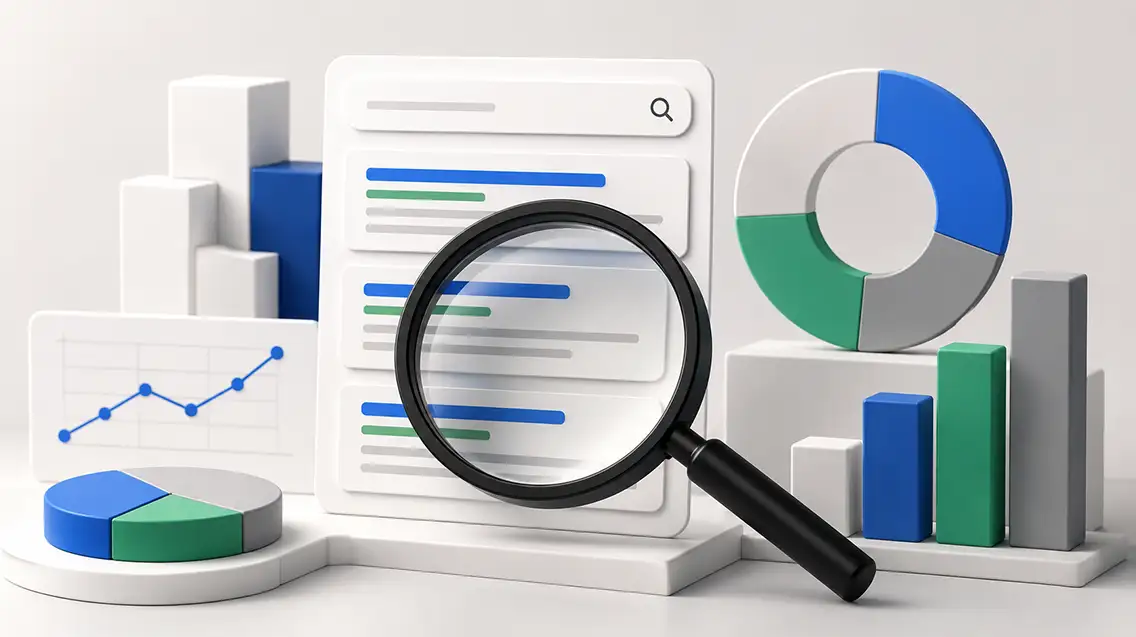
Most companies lose traffic not because they produce bad content, but because they create pages without understanding what Google really wants to deliver to users.
Many businesses still treat SEO as mass article production. They publish content, repeat keywords, and hope for results. But Google doesn't rank pages in isolation. It compares intent, formats, depth, and problem-solving ability.
Without SERP analysis, you're producing content in the dark. And in digital marketing, operating in the dark is expensive.
Index
INSIGHT: The SERP is Google's most honest report. It shows exactly what the search engine considers relevant for a given query. Ignoring it means producing content based on opinion, not evidence.
What is SERP analysis
SERP stands for "Search Engine Results Page" – Google's results page. SERP analysis involves studying the results displayed for a specific keyword to understand:
- The type of content prioritized
- The dominant search intent
- Competitor patterns
- The required depth level
- Formats favored by the algorithm
In practice, the SERP works as a strategic map. It shows what Google expects to deliver to the user. And that completely changes how you create content.
For example: if you search for "what is SEO", Google tends to prioritize educational, introductory content. But for a search like "SEO agency", results have strong commercial intent. This changes language, structure, CTAs, depth, and conversion strategy.
That's why we recommend understanding search architecture before producing any page. This concept connects directly with Growth Architecture and What is SEO.
Producing content without SERP analysis is like investing in media without targeting.
You might generate visits, but you'll hardly achieve predictable growth.
Why most businesses fail at SEO
Many companies still believe SEO is: publishing lots of articles, repeating keywords, inserting random backlinks. But Google has evolved.
Today, Google tries to understand: what problem the user wants to solve, which format delivers the best answer, which page generates the most satisfaction.
When content ignores search intent, users enter and leave quickly. Google interprets this as low relevance. The result is a chain reaction: lower dwell time, lower CTR, lost rankings, increased acquisition costs. Traffic stops being a strategic asset and becomes vanity.
- Companies that grow with SEO: understand search behavior, structure content based on SERP, integrate SEO with conversion, continuously update pages.
- Companies that don't evolve: produce generic content, superficially copy competitors, ignore search intent, don't analyze real data.
What the SERP reveals about your competitors
The SERP is an open field of competitive intelligence. By analyzing Google's results, you can identify: who dominates the market, which approach works, what content the algorithm favors, and where competitive gaps exist.
Often, competitors aren't winning because they're better. They're winning because they better understood the search intent.
If the top results have complete guides, scannable structures, visual content, quick answers, and optimized FAQs, but your page only delivers generic text, the problem isn't lack of backlinks. It's strategic misalignment.
SEO alone rarely sustains predictable growth.
When the website isn't designed to convert, traffic enters and leaves without commercial opportunity. That's why SERP analysis must also connect to the website, user experience, conversion, and the commercial journey.
Also read: Website Development and What is Paid Traffic.
How to perform a strategic SERP analysis
Identify search intent
This is the first step. Ask: "What does the user really want when searching for this?" Intent typically falls into: informational, commercial, navigational, transactional.
If the SERP shows educational guides → informational intent; comparisons → commercial; products → transactional. You need to align your page with the dominant pattern. Otherwise, Google will hardly prioritize your content.
Analyze content patterns
Observe: average article length, heading structure, image frequency, video usage, FAQs, technical depth. The SERP leaves clear clues. If top results have extremely complete content, a shallow text will struggle to compete. But more content doesn't mean more results: strategic content is different from bloated content.
Evaluate authority and structure
Not all competition is impossible. Many strong results have established brands, old domains, large backlink volumes, but they often have poor UX, weak structure, low scannability, or outdated content. This is where smart companies gain ground. When the experience is better, users respond better. And Google notices that.
- What to evaluate: domain authority, content quality, navigation clarity, mobile structure, speed, CTA quality.
- What to ignore: just text volume, just DR/DA, just backlinks.
Discover hidden opportunities
Most people analyze only the first few links. But real opportunities appear in Featured Snippets, People Also Ask, related searches, depth gaps, and outdated content. Many pages rank without truly solving the user's problem. That's the space where smart strategies grow.
How to turn SERP analysis into growth
SERP analysis shouldn't end with content. It needs to feed: SEO strategy, website structure, conversion, sales funnel, and paid traffic. This is where most companies break. They do SEO separately, traffic separately, website separately. Without integration, each channel operates as an isolated piece. And predictable growth doesn't come from isolated pieces. It comes from architecture.
Practical example: A company manages to rank well for a strategic keyword. But the site is slow, the CTA is weak, navigation is confusing, and there's no structured lead capture. Traffic arrives. Conversion doesn't happen. Result: lots of visits, little revenue. SEO without conversion structure creates unproductive audiences.
Strategic Diagnosis
If your website generates visits but doesn't turn traffic into real opportunities, the problem probably isn't just SEO. The entire structure needs to be analyzed. Request a strategic diagnosis from ROMA Digital and discover how your SERP is positioned, where the bottlenecks are, and how to build a predictable growth architecture.
Request strategic diagnosisROMA Digital's role
At ROMA Digital, SERP analysis isn't an operational task. It's strategic intelligence. We analyze: search intent, competitor structure, conversion potential, website architecture, and commercial journey.
Because ranking without converting doesn't solve your business problem. Our approach integrates strategic SEO, paid traffic, and conversion-focused websites. Everything connected in a predictable digital architecture. Without this, companies get stuck in trial-and-error cycles. With structure, growth no longer depends on luck.
Want to learn more? See how we structure Growth Architecture.
SERP analysis is not about ranking
The true purpose of SERP analysis isn't to win positions. It's to understand behavior. When you understand what users search for, what Google prioritizes, what competitors do, and what's missing from the experience, you stop producing random content and start building strategic digital assets.
SERP analysis is, at its core, a real-time market reading. Those who master it stop fighting for attention through guesswork and start building predictable growth.