
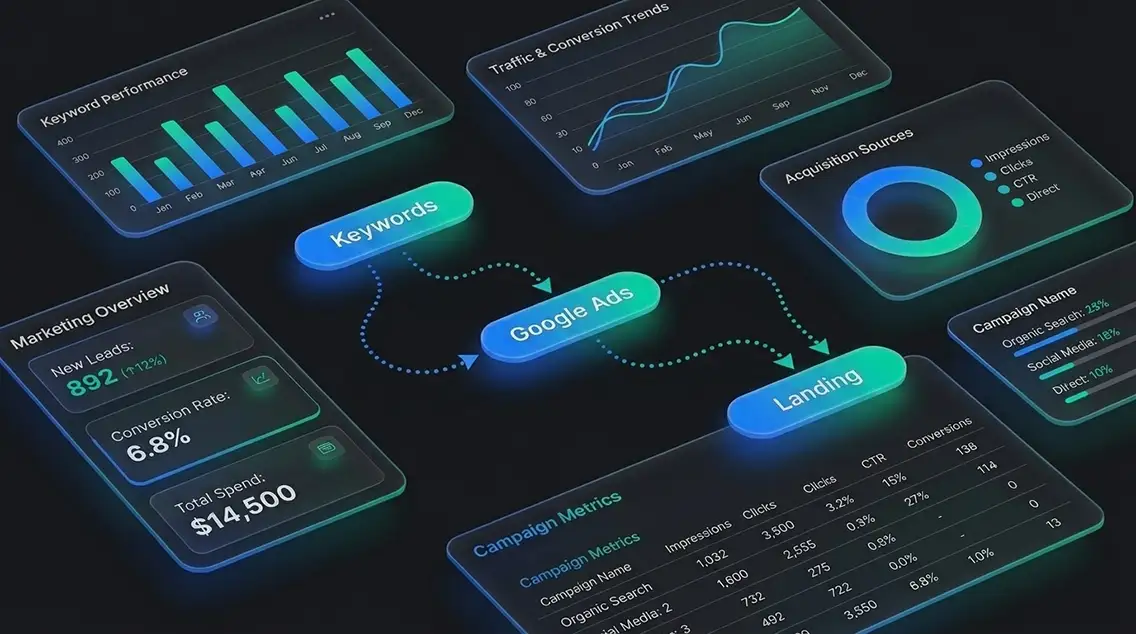
Creating a Google campaign is not difficult. The hard part is making it generate real results.
Anyone can upload ads to Google Ads in a few minutes. But most stop there. Result: clicks come in, money goes out, and opportunities don't appear.
If you're looking to create a Google campaign, you need to understand one thing: it's not about ads. It's about structure.
Index
Key Insight:
Google campaigns don't fail due to lack of investment. They fail due to lack of architecture.
What is creating a Google campaign
Creating a Google campaign means setting up paid ads to appear when someone searches for a specific term.
In practice, you choose:
- Keywords
- Audience
- Budget
- Ad message
And Google shows your ad to those who are searching.
Simple? On the surface, yes.
But here's the point almost nobody mentions: appearing does not mean converting.
Attention:
If you believe paid traffic alone solves everything, you're treating the symptom, not the cause.
To dive deeper, see also: What is paid traffic
The problem with campaigns that don't perform
Most campaigns follow the same script:
- Active ad
- Clicks happening
- Qualified leads
- Consistent sales
The business owner looks at the dashboard and sees numbers. But the cash register doesn't follow.
This happens because the process is broken in the middle.
When the ad leads to a website that wasn't designed to convert, the user enters and leaves without action. The investment becomes a cost.
And then the cycle begins:
- Increase the budget
- Test new ads
- Blame the market
But the problem isn't Google.
Why most campaigns fail
Let's get straight to the point: campaigns fail because they are treated as isolated actions.
There is no connection between:
- Acquisition (ad)
- Conversion (website)
- Optimization (data)
Result?
You attract traffic, but you don't capture value.
See the wrong pattern:
- Choose generic keywords
- Create a generic ad
- Send to the institutional page
- Don't measure conversion
Now the correct pattern:
- Well-defined search intent
- Ad aligned with the user's pain point
- Page focused on conversion
- Constant monitoring and optimization
Without this, you're paying for visits, not opportunities.
To better understand the role of SEO in this structure: What is SEO
How to structure campaigns focused on results
Creating a Google campaign that works requires integration.
Here come the pillars of growth architecture.
Clear objective and search intent
Before creating any campaign, you need to answer:
- What do you want to generate? Lead? Sale? Appointment?
- At what stage is the customer?
Searching for "what is digital marketing" is different from "marketing agency in SP".
Mixing this destroys performance.
A campaign without clear intent becomes uncontrolled spending.
Keyword structure and segmentation
Here's the classic mistake: wanting volume over quality.
Broad words bring traffic. Specific words bring business.
Example:
- digital marketing
- digital marketing consulting for industry
The more aligned with intent, the higher the conversion.
Conversion-oriented landing page
This is the most neglected point.
You can have the best ad in the world. If the page doesn't convert, nothing works.
An effective page needs:
- Clear promise
- Proof of value
- Direct CTA
- Friction reduction
When this doesn't exist, the visitor sees no reason to act.
To dive deeper: Website development
Continuous data-driven optimization
A campaign is not something you create and forget.
You need to analyze:
- Conversion rate
- Cost per lead
- Keywords that perform
And adjust constantly.
Without this, the algorithm works in the dark.
Practical application: from zero to lead generation
Let's simplify the process:
- Define the objective
Ex: generate qualified leads - Choose keywords with commercial intent
No generic terms - Create ads aligned with the pain point
Say what the customer wants to hear - Direct to a conversion page
No homepage - Set up tracking
Without data, there's no optimization - Optimize weekly
Cut what doesn't work. Scale what does.
A good campaign isn't the one that generates the most clicks. It's the one that generates the most opportunities with predictability.
Free strategic diagnosis
If you already invest in Google Ads and don't see consistent returns, the problem isn't the isolated ad. It's the structure. Request a free diagnosis and find out where your operation is leaking opportunities.
Request strategic diagnosisROMA Digital's role
ROMA Digital doesn't create campaigns. It structures growth.
This means integrating:
- Strategic SEO
- Paid traffic
- Conversion-oriented websites
Everything connected in an architecture that turns visits into opportunities.
While the market sells campaigns, ROMA builds systems.
And that's what changes the game.
Understand more about this concept: Growth Architecture
Creating a Google campaign without structure is a loss
Creating a Google campaign is easy. Generating predictable results is another story.
If you continue treating ads as an isolated solution, you'll stay stuck in the cycle:
invest, test, get frustrated, repeat.
The turning point happens when you understand that growth doesn't come from tools. It comes from structure.
The question is no longer "how to create a Google campaign".
The right question is: is your operation ready to turn traffic into revenue?
If the answer is no, the problem isn't Google.
It's the foundation.