
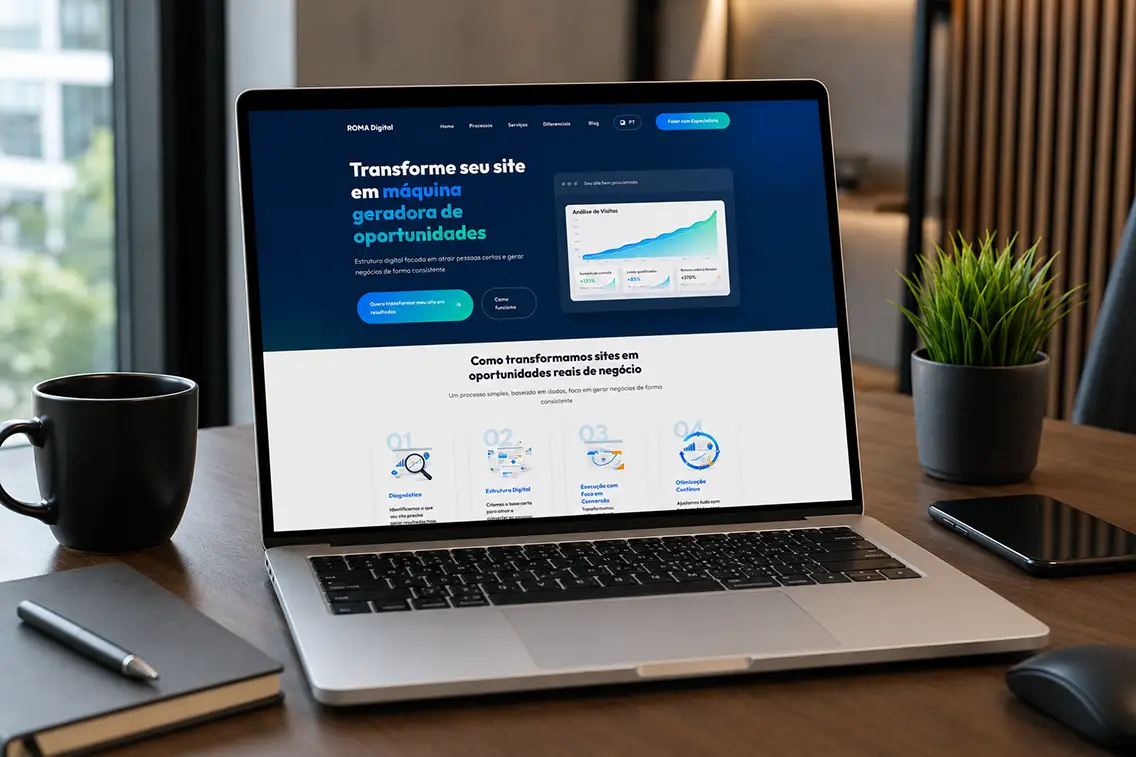
Most companies don't have a traffic problem. They have a structure problem.
When the website wasn't built to generate opportunities, any marketing investment becomes silent waste. The visitor arrives, browses for a few seconds, and disappears. No contact. No conversion. No predictability.
That's why a professional website is no longer just an institutional piece. Today, it's the foundation of digital acquisition.
Companies that grow consistently don't rely solely on ads, social media, or referrals. They build a digital architecture capable of attracting, converting, and continuously optimizing.
Index
A professional website doesn't exist just to "be online." It exists to turn attention into commercial opportunity.
What is a professional website
A professional website is a digital structure created to generate business results.
This means it's not developed thinking only about aesthetics. It is planned to:
- Attract qualified visitors
- Position the company on Google
- Generate immediate trust
- Guide the user toward conversion
- Integrate marketing, sales, and data
A professional website needs to function as a commercial asset.
The difference seems subtle. But it changes everything.
A common website is usually born from the question: "How do we want to look?"
A strategic website is born from another: "How will we generate predictable growth?"
This difference defines whether digital will be just presence or real opportunity generation.
If you still don't understand how this connects to the company's structure, it's worth diving deeper into the concept of digital architecture at Growth Architecture.
Websites made just to "look pretty" generally ignore SEO, conversion, and user journey. The result is predictable: low traffic and almost no lead generation.
The problem with websites that don't generate results
Many companies invest in paid traffic, social media, and commercial campaigns without realizing that the main bottleneck is the website.
Marketing may even bring visitors. But the website doesn't sustain the operation.
When the structure is weak, the visitor finds:
- slow pages
- confusing navigation
- generic messages
- lack of social proof
- poor forms
- inconsistent mobile experience
The consequence comes quickly.
Cost per lead rises. Conversion rate plummets. The sales team receives unqualified contacts. The business owner concludes that "digital marketing doesn't work."
But the problem wasn't with the media. It was with the foundation.
Imagine investing thousands of dollars to bring people to a disorganized physical store with no service and no clear direction. That's exactly what happens when companies advertise without having a professional website.
- Traffic without conversion
- Visitors without trust
- Marketing without predictability
That's why mature companies treat the website as growth infrastructure.
Why most websites fail
The most common mistake is treating the website as an isolated project.
In practice, many companies:
- hire a designer without strategy
- create generic copy
- ignore SEO
- don't think about conversion
- don't analyze user behavior
The result is a beautiful but unproductive website.
There's a clear pattern to this.
When SEO isn't planned from the start, the website doesn't gain organic relevance. Without relevance, it's totally dependent on paid media. When the experience is poor, traffic doesn't convert. Then investment needs to keep increasing to compensate for structural inefficiency.
In the end, marketing becomes an expensive and unstable machine.
That's why professional website development needs to consider the entire digital ecosystem.
This includes:
- Technical SEO
- Information architecture
- UX
- Speed
- Copywriting
- Tracking
- CRM integration
- Conversion-oriented pages
If you want to better understand how SEO participates in this process, check out What is SEO.
SEO is not an "extra" added later. When the website is born without an optimized structure, fixing it afterward is usually more expensive and slower.
What a professional website needs to have
Conversion-oriented structure
The main function of a professional website is to transform visitors into opportunities.
This requires a clear journey.
The user needs to quickly understand:
- what the company does
- who it's for
- why to trust
- what next step to take
Companies that convert well reduce friction.
They use:
- Clear CTAs
- Social proof
- Strategic landing pages
- Smart forms
- Persuasive copy
Meanwhile, companies without structure accumulate confusing pages and generic communication.
Strategic SEO from the ground up
SEO isn't just about appearing on Google. SEO is about building a sustainable digital presence.
A professional website needs to be born with:
- Correct semantic structure
- Friendly URLs
- Optimized speed
- Strategic content
- Efficient navigation architecture
Without this, the company becomes dependent on paid media forever. And dependency never generates predictability.
To dive deeper: What is SEO.
Performance and user experience
Speed directly impacts conversion.
Today, a few seconds decide whether the visitor stays or leaves the site.
Additionally, the experience needs to be smooth on mobile. Most current traffic happens on smartphones. Yet many companies still have websites that are difficult to navigate on mobile.
This destroys the experience.
- Bad buttons
- Slow loading
- Illegible text
- Confusing menus
All of this silently reduces conversion.
Integration with paid traffic and automation
A professional website doesn't operate alone.
It needs to integrate with:
- Google Ads campaigns
- Meta Ads
- CRM
- Automation tools
- Analytics
- Remarketing tools
When this integration exists, marketing stops being trial and error. Decisions become data-driven.
If you want to understand how paid traffic fits into this structure: What is paid traffic.
How to transform the website into an acquisition channel
The first step is to abandon the "institutional website" logic.
Today, the website needs to operate as a digital salesperson.
This requires:
- Clear positioning
- Strategic pages
- Search-oriented content
- Media integration
- Continuous optimization
Companies that achieve this transform the website into a predictable asset. They stop relying exclusively on referrals.
A common example: a company invests in Google Ads but sends traffic to a generic homepage. Conversion is low. Then, it creates specific pages for each service, improves copy, adds social proof, and optimizes loading. The same traffic starts generating much better results.
The investment barely changed. The structure changed.
This is the point many companies ignore: marketing without structure increases cost. A well-built structure increases efficiency.
If your company doesn't yet have a website prepared for growth: Website development.
- Fast website
- Structured SEO
- Strategic pages
- Data integration
- Conversion focus
Does your company generate traffic, but the website doesn't convert?
Request a free strategic diagnosis and discover where your digital structure is losing opportunities.
Request strategic diagnosisROMA Digital's role
ROMA Digital does not treat websites as isolated pieces. The company works with growth architecture.
This means integrating:
- Strategic SEO
- Paid traffic
- Conversion-oriented website development
The goal is not just to "make a beautiful website." The goal is to build a structure capable of generating predictability.
Many companies arrive after investing in campaigns with no return, useless redesigns, traffic without conversion, and agencies focused only on aesthetics.
The problem is rarely a specific action. The problem is the absence of a system.
ROMA acts precisely on this point: building digital structures prepared for acquisition, conversion, and continuous growth.
Professional website is not a cost. It's infrastructure.
Companies that treat the website as an operational detail remain dependent on constant effort to grow.
Companies that treat the professional website as infrastructure build predictability.
That's the difference.
The digital market has become more competitive. More expensive. More disputed.
Without structure, every campaign gets harder. Without conversion, every click costs more. Without positioning, your company becomes just another option.
A professional website doesn't solve everything alone. But without it, almost nothing is sustainable in the long term.
The right question is not: "How much does a professional website cost?"
The strategic question is: "How much does it cost to keep growing without structure?"