
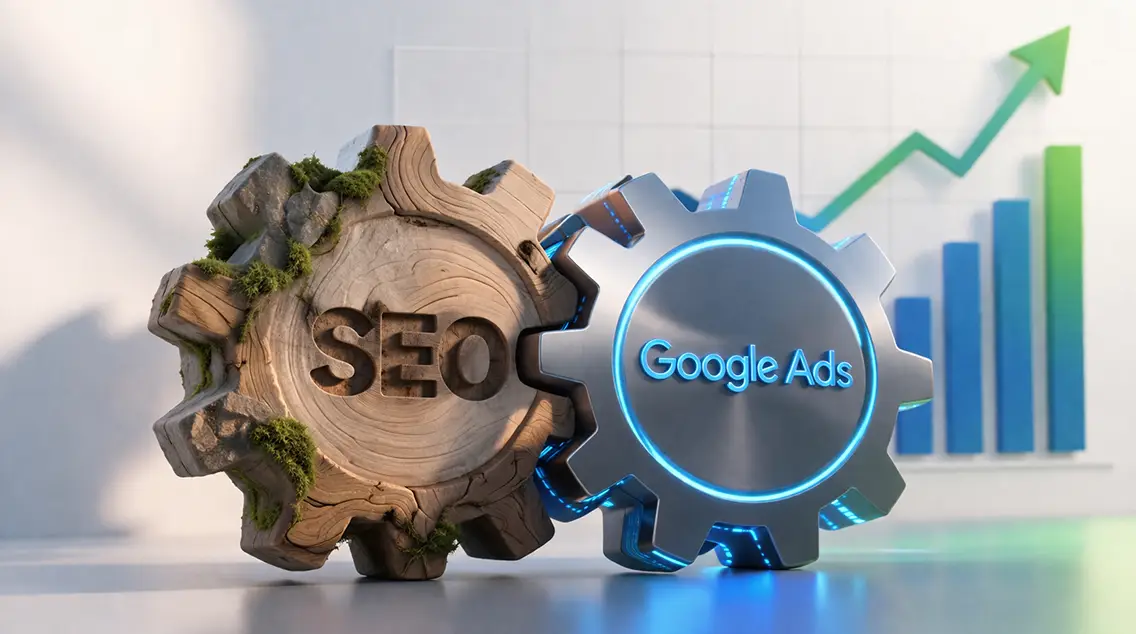
The question "Google Ads vs SEO" seems technical, but in practice it's a symptom of a bigger problem: the absence of a structured digital strategy.
Companies don't fail to grow because they choose the wrong channel. They fail to grow because they operate with isolated actions.
Google Ads generates immediate results through paid advertising, while SEO builds consistent organic traffic over the long term.
The best strategy isn't choosing between the two, but integrating them into a digital structure that generates predictable and sustainable growth.
Index
- What is Google Ads and How It Works
- What is SEO and Why It's Strategic
- Direct Comparison: Google Ads vs SEO
- Speed of Results
- Cost and Scalability
- Predictability
- Sustainability
- The Mistake Most Companies Make
- Why Choosing Between SEO and Ads is the Wrong Question
- The Digital Structure That Really Generates Results
- Practical Application: How to Combine SEO and Google Ads
- ROMA Digital's Role in Building This Structure
- Stop choosing channels, start building systems
What is Google Ads and How It Works
Google Ads is the most direct way to generate immediate traffic.
You pay to appear in top positions and start receiving clicks quickly.
Advantages:
- Immediate results
- Investment control
- High volume predictability
Structural limitation:
Stop investing, stop generating leads.
Paid traffic is a machine that works while there's fuel. Without continuous investment, opportunity generation ceases immediately.
What is SEO and Why It's Strategic
SEO is the construction of organic presence on Google.
Instead of paying for each click, you build digital assets that attract traffic continuously.
Advantages:
- Recurring traffic
- Cost reduction over time
- Brand authority
Structural limitation:
Requires time and consistency.
SEO isn't a quick fix. It's an investment that begins to generate significant returns after months of continuous strategic work.
Direct Comparison: Google Ads vs SEO
To understand how each channel positions itself, it's necessary to analyze four fundamental dimensions of digital marketing.
Speed of Results
- Ads: immediate
- SEO: medium/long term
Google Ads allows you to start generating traffic on the same day of campaign setup. SEO, on the other hand, requires maturation periods that can vary from 3 to 12 months for expressive results.
Cost and Scalability
- Ads: cost proportional to growth
- SEO: cost diluted over time
In paid traffic, the more you want to grow, the more you need to invest. In SEO, maintenance costs tend to decrease proportionally to returns as site authority consolidates.
Predictability
- Ads: predictable in the short term
- SEO: predictable in the long term
Ads campaigns allow daily and weekly volume projections. SEO offers predictability of trends and accumulated growth, but with less precision in the short term.
Sustainability
- Ads: continuous dependence
- SEO: cumulative asset
Paid traffic is a resource that runs out when investment stops. SEO builds a digital asset that continues generating value even with reduced maintenance investment.
Want to know which strategy is ideal for your business?
Every company has a different moment and context. Discover the ideal structure for your digital growth.
Request free analysisThe Mistake Most Companies Make
The biggest failure isn't in choosing SEO or Google Ads.
It's in treating channels as isolated solutions.
Companies invest in paid traffic without conversion structure. Or produce content without search intent strategy.
Common result:
Traffic without business generation.
Visits not converted into leads. Leads not converted into sales. Investment without measurable return.
Why Choosing Between SEO and Ads is the Wrong Question
The right question isn't:
"Which channel is better?"
But rather:
"How to build a system that transforms search into revenue?"
SEO and Google Ads don't compete. They fulfill different roles within the same architecture.
Strategic insight:
Integrated channels generate exponential results.
When SEO and Ads work together, each amplifies the other's results.
The Digital Structure That Really Generates Results
Predictable growth requires three pillars:
1. Acquisition
- SEO for recurring demand
- Ads for scale and speed
2. Conversion
- Site structured for lead generation
- Decision-oriented pages
3. Intelligence
- Data for continuous optimization
- Integration between channels
Fundamental reality:
Without this structure, any channel fails.
Excellent SEO or Ads work doesn't compensate for the absence of an efficient conversion system.
Practical Application: How to Combine SEO and Google Ads
An efficient strategy works like this:
-
Use Google Ads to validate keywords and generate immediate leads
Test search terms with paid campaigns before investing in organic content. -
Use SEO to consolidate these keywords in the long term
Transform validated keywords into strategic content and organic authority. -
Direct both to pages optimized for conversion
Traffic without conversion structure is a waste of resources. -
Use Ads data to prioritize SEO content
Campaign metrics reveal high-value search intentions.
Result:
- Short term with lead generation
- Long term with cost reduction
- Growth predictability
ROMA Digital's Role in Building This Structure
Most companies execute actions.
Few build systems.
ROMA Digital acts exactly at this point: transforming isolated channels into a predictable growth architecture.
This involves:
- Strategic SEO planning
- Intelligent paid traffic management
- Conversion-oriented website creation
- Integration between acquisition and revenue
Our focus:
It's not generating traffic. It's generating consistent sales pipeline.
Because digital growth doesn't come from campaigns. It comes from structure.
Stop choosing channels, start building systems
So, which one to use?
Google Ads vs SEO isn't a competition.
It's a false dichotomy.
Companies that grow don't choose between channels. They build systems where each channel fulfills a strategic role.
In the end, the question stops being:
"Where to invest?"
And becomes:
"How to structure my digital growth?"