
The biggest lie in digital marketing is believing that simply publishing a website is enough to start receiving visits.
Many companies invest in building a website and expect customers to show up naturally. In practice, that rarely happens. Promoting a website online requires planning, strategy, and a structure capable of generating traffic and turning visitors into real business opportunities.
The problem isn't just in promotion. It's in the absence of a complete system that connects traffic acquisition, conversion, and continuous optimization.
Index
- What it means to promote your website online
- Why most websites don't receive visits
- The mistakes that block digital growth
- How to promote your website online strategically
- How to apply this strategy in practice
- ROMA Digital's role
- Promoting a website online requires structure
- FAQ – Frequently Asked Questions
Promoting a website online is not an action. It's a system. When SEO, paid traffic, content, and conversion work together, the site stops being a digital showcase and starts functioning as an opportunity-generating machine.
What it means to promote your website online
Many people associate promotion only with running ads or posting on social media. That view is limited.
Promoting a website online means creating multiple paths for potential customers to find your company when they are searching for solutions.
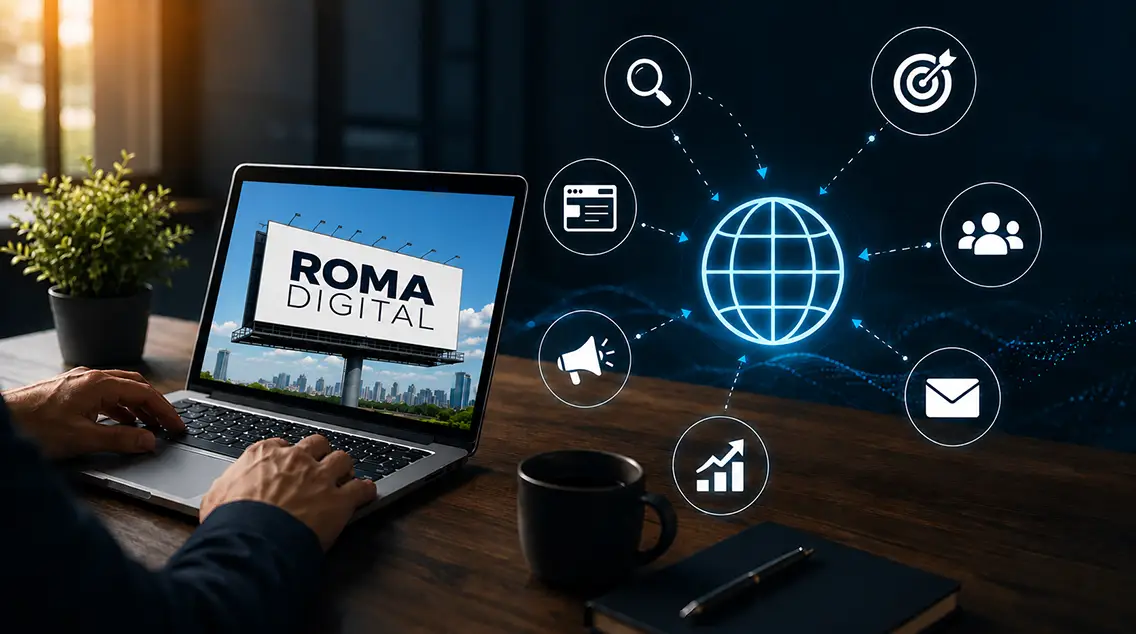
This can happen through:
- Organic results on Google
- Paid traffic campaigns
- Content marketing
- Social media
- Email marketing
- Partnerships and digital referrals
The goal is not just to generate visits. The goal is to generate qualified visits.
The difference is huge. A thousand uninterested visitors buy less than a hundred visitors with clear intent to hire.
Why most websites don't receive visits
Most websites suffer from the same problem: lack of structure.
Companies invest in website development, publish a few pages, and believe that will be enough to generate demand.
It doesn't work that way.
Google needs to find, understand, and trust your content. Users need to discover your brand. And the site needs to demonstrate value quickly.
When that doesn't happen, the result is predictable.
Few visits. Few contacts. Few sales.
The problem isn't necessarily the product or service. The problem is in the digital architecture.
If nobody finds your website, it doesn't generate traffic. If traffic doesn't arrive, there are no opportunities. If there are no opportunities, growth remains dependent on referrals and manual commercial efforts.
The mistakes that block digital growth
Some mistakes appear repeatedly in digital marketing diagnoses.
Focusing only on social media
Social media can generate reach, but they are rented assets.
You don't control the algorithm. You don't control distribution. You don't control the audience.
Your website, on the other hand, is an owned asset.
Ignoring SEO
Many companies are unaware of the importance of SEO. By not investing in optimization, they lose space to competitors who appear first on Google.
To better understand this process, it's worth exploring this content on what is SEO.
Investing only in ads
Ads generate speed. But speed without structure creates dependency. When the campaign stops, traffic disappears.
Having a site that doesn't convert
Even when promotion works, many websites waste opportunities. The visitor enters. Doesn't find clarity. Doesn't understand the next step. And leaves.
Generating traffic to a poorly structured site is like filling a leaky bucket. Investment increases, but results don't follow.
How to promote your website online strategically
Effective promotion happens when different channels work in an integrated way.
SEO to generate continuous traffic
SEO is one of the most sustainable ways to promote a website online. By positioning pages for relevant keywords, your company gets found exactly when potential customers are searching for solutions.
Among the benefits are:
- Recurring traffic
- Reduced acquisition cost
- Increased digital authority
- Sustainable growth
Learn more at what is SEO.
Paid traffic to accelerate results
SEO builds a solid foundation. Paid traffic accelerates the process. Campaigns on Google Ads and other platforms allow you to generate immediate visibility for strategic keywords.
The point is that ads work better when they direct users to pages prepared to convert.
More details at what is paid traffic.
Content to build authority
Producing content answers questions, educates the market, and expands your digital presence. Additionally, content strengthens SEO and creates relationship opportunities with potential customers.
When an article solves a real problem, it keeps attracting visitors for months or even years. That's one of the main advantages of content marketing.
Conversion-oriented website
It's not enough to promote. The site needs to transform traffic into opportunities. This requires:
- Clear structure
- Good navigation experience
- Strategic pages
- Calls to action
- Efficient forms
When a site is built only to look good, it loses its main function: generating business.
See also website development.
How to apply this strategy in practice
Imagine a B2B services company. It invests only in ads. Receives visits. Generates some contacts. But costs keep rising.
Now imagine another scenario. The company combines:
- SEO
- Strategic content
- Paid traffic
- Conversion-optimized site
In this model, ads generate immediate results while SEO builds long-term assets. Over time, part of the traffic starts arriving without depending exclusively on paid media.
The result is more predictable and sustainable growth. This logic is directly linked to the concept of growth architecture.
Does your website receive few visits?
Or does it receive visits but doesn't generate opportunities? A strategic diagnosis can identify the bottlenecks blocking your digital growth and reveal where the biggest demand generation opportunities are.
Request strategic diagnosisROMA Digital's role
At ROMA Digital, we don't treat SEO, paid traffic, or website development as isolated initiatives.
Each element is part of a growth architecture. This approach allows us to create predictable systems of acquisition and conversion.
While many companies look for shortcuts, ROMA works on building structures that sustain long-term results.
The goal is not just to increase traffic. The goal is to generate consistent commercial opportunities.
Because predictable digital growth doesn't come from disconnected actions. It comes from strategy, integration, and execution.
FAQ – Frequently Asked Questions
How to promote your website online?
To promote your website online effectively, you need to combine SEO, paid traffic, strategic content, and a site prepared to convert visitors into opportunities. Isolated actions may generate temporary traffic, but predictable growth depends on an integrated digital structure.
Why do most websites not receive visits?
Most websites don't receive visits because of a lack of structure. Companies invest in website development, publish a few pages, and believe that will be enough to generate demand. Google needs to find, understand, and trust the content. Users need to discover the brand. And the site needs to demonstrate value quickly.
SEO or paid traffic: which is better to promote a website?
Neither is better alone. SEO builds a solid foundation of sustainable traffic, while paid traffic accelerates immediate results. The most efficient strategy combines both: ads generate immediate results while SEO builds long-term assets.
Are social media enough to promote a website?
No. Social media can generate reach, but they are rented assets. You don't control the algorithm, distribution, or audience. Your website is an owned asset. Promoting a website online requires multiple channels, not just social media.
How long does it take for a website to start receiving organic traffic?
The time varies depending on niche competition, content quality, and domain authority. On average, new sites begin to see significant SEO results between 3 and 6 months. Paid traffic, on the other hand, can generate visits immediately.
What is more important: traffic or conversion?
Conversion. A thousand uninterested visitors buy less than a hundred visitors with clear intent to hire. Generating traffic to a poorly structured site is like filling a leaky bucket. Investment increases, but results don't follow.
Promoting a website online requires structure
Promoting a website online is much more than running ads or sharing links on social media.
Companies that grow consistently understand that traffic is only part of the equation.
When SEO, content, paid media, and conversion work together, the site transforms into a strategic asset capable of generating opportunities continuously.
The most important question isn't "how to promote a website online?".
The right question is: Is your website part of a growth structure or does it still depend on isolated actions to generate results?