
Most companies don't have a traffic problem. They have a direction problem. And it all starts with choosing the wrong Google keywords.
You might even show up in searches. You might even generate clicks. But if the keywords aren't connected to buying intent and a conversion structure, the result is simple: visits come and go without leaving revenue.
Index
Key Insight:
Keywords are not for generating traffic. They are for attracting the right audience within a system that converts.
What are keywords on Google
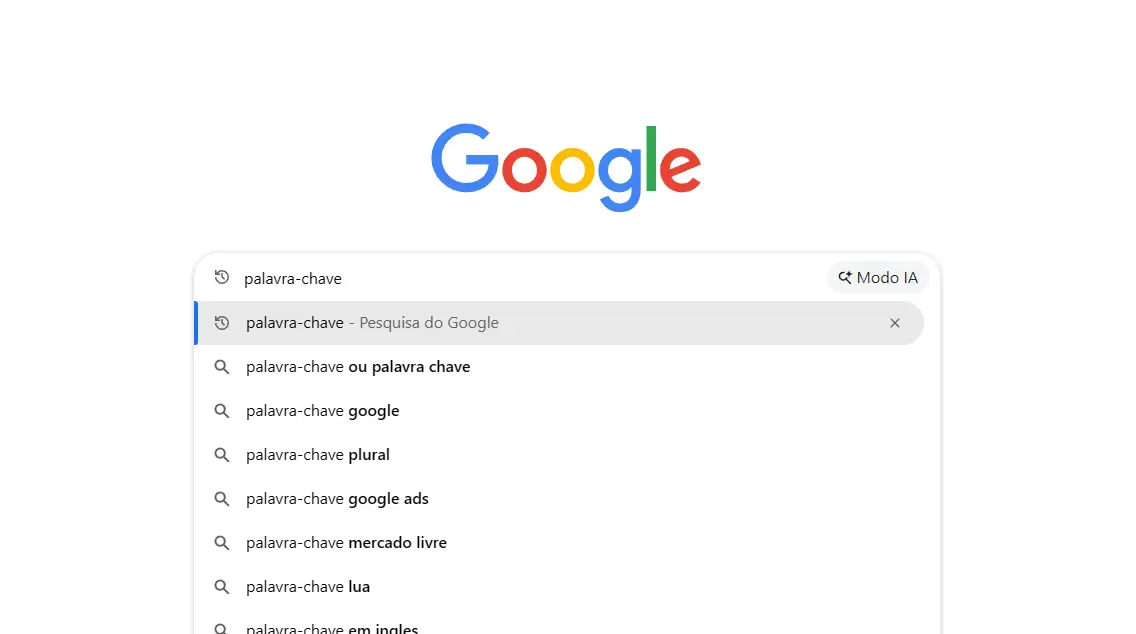
Keywords are the terms users type into Google to find answers, products, or services.
Simple in definition. Complex in execution.
When someone searches for "urgent labor lawyer," there's a clear intent. When they search for "what is labor law," the intent is different.
And here's the point: it's not about the word. It's about the user's moment.
Attention:
Choosing keywords based solely on search volume is a classic mistake. High volume without commercial intent generates vanity, not revenue.
The problem with using keywords without strategy
Companies treat keywords as a loose list.
They create random content. They run disconnected ads. They publish without criteria.
Predictable result:
- Unqualified traffic
- Low conversion
- Negative ROI
When there is no structure, every click becomes an isolated cost.
When the site isn't designed to convert, traffic enters and leaves without action. The marketing investment becomes a recurring expense, not growth.
Why most people get keyword selection wrong
The error is not in the tool. It's in the mindset.
Companies do this:
- Choose overly generic words
- Ignore search intent
- Don't connect SEO with sales
- Produce content without a goal
Meanwhile, the more strategic market does the opposite:
- Maps the customer journey
- Works keywords by funnel stage
- Integrates SEO with paid traffic
- Optimizes pages for conversion
The difference is not in the effort. It's in the system.
How to use keywords within a growth architecture
Keywords only generate results when they are part of a larger structure.
Here enters the central concept: growth architecture.
It's not about isolated SEO. Not about isolated paid traffic. Not about having a beautiful website.
It's about integration.
Search intent before volume
Every keyword needs to answer one question:
Does it bring someone ready to move forward or just curious?
Practical example:
- "what is digital marketing" → top of funnel
- "digital marketing agency price" → bottom of funnel
Without this reading, you attract people at the wrong moment.
SEO as a structural foundation
SEO organizes your growth.
It defines:
- Which content to produce
- Which pages to rank
- Which terms to target
Without SEO, you depend exclusively on paid media.
And dependency never generates predictability.
Dive deeper here: What is SEO
Integration with paid traffic
SEO takes time. Paid traffic accelerates it.
But when both work together, the result scales.
You validate keywords through paid. Then consolidate them organically.
This reduces acquisition cost over time.
Learn more: What is paid traffic
Website ready for conversion
There's no point nailing the keyword and missing the destination.
If the website doesn't convert, the system breaks.
A good website:
- Guides the user
- Reduces friction
- Directs action
Otherwise, you pay to attract people who do nothing.
See more: Website development
Practical application: how to choose keywords
Now the real process.
1. Understand your customer
What problems do they have? How do they search for a solution?
Without this, you are guessing.
2. List initial terms
Start with the basics:
- Your service
- Your location
- Your specialty
3. Use research tools
Some options:
- Google Keyword Planner
- Ubersuggest
- SEMrush
But remember: a tool does not replace strategy.
4. Analyze search intent
Ask yourself:
Does this search indicate curiosity or decision?
5. Prioritize words with business potential
It's not always the most searched. It's the most profitable.
A keyword with less volume but high intent can generate more revenue than a thousand empty visits.
Free strategic diagnosis
If you currently invest in digital marketing but can't predict results, the problem is likely in the structure. Request a free diagnosis and discover where your strategy is breaking.
Request strategic diagnosisROMA Digital's role
Most companies try to solve the problem with isolated actions.
More content. More ads. More investment.
But without structure, this only increases waste.
ROMA Digital acts differently.
We build a growth architecture where:
- SEO attracts
- Paid media accelerates
- The website converts
Everything integrated.
Nothing isolated.
Understand the full concept: Growth Architecture
Google keywords without strategy don't generate results
Google keywords are just the entry point.
What defines the result is the system behind it.
Without structure:
- Traffic doesn't become leads
- Leads don't become customers
- Investment doesn't become growth
With structure:
- Every keyword has a function
- Every page has an objective
- Every click has a destination
The question is not whether you are using keywords.
The question is: are they connected to a system that generates predictable revenue?
If the answer is no, you don't have a strategy. You just have attempts.