
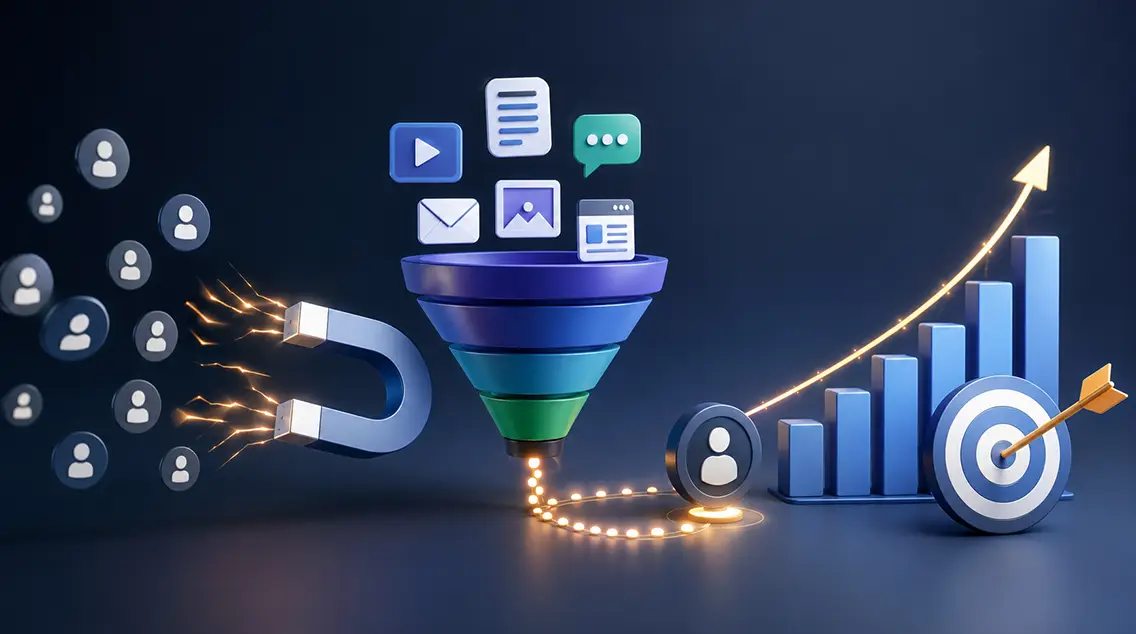
Most companies don't have a traffic problem. They have a structure problem.
Many organizations invest in ads, social media, and content production, yet continue to struggle to generate commercial opportunities consistently. In this scenario, Inbound Marketing emerges as a methodology capable of transforming visitors into leads and leads into customers.
The problem is that many companies treat Inbound Marketing as an isolated action. And predictable growth doesn't happen that way.
When acquisition, conversion, and relationship are not connected, the result is wasted investment and low business generation.
Index
- What is Inbound Marketing
- The problem with isolated marketing actions
- Why many Inbound Marketing strategies fail
- The pillars of an efficient Inbound Marketing strategy
- How to apply Inbound Marketing in practice
- ROMA Digital's role
- FAQ – Frequently Asked Questions
- Inbound Marketing: the difference between growing and scaling
Inbound Marketing is not content production. Inbound Marketing is building a system capable of attracting visitors, turning interest into commercial opportunity, and generating revenue continuously. Without structure, content becomes a cost. With structure, it becomes a growth asset.
What is Inbound Marketing
Inbound Marketing is a methodology focused on attracting potential customers through relevant content, SEO, automation, and relationship building.
Unlike traditional marketing, which interrupts the audience's attention, attraction marketing works to be found exactly when there is a need.
The process typically follows four stages:
- Attract visitors
- Convert visitors into leads
- Nurture the relationship
- Turn leads into customers
This model accompanies the entire consumer buying journey.
When well implemented, Inbound Marketing creates a constant flow of commercial opportunities.
What is the difference between Inbound Marketing and traditional marketing?
While traditional marketing seeks to interrupt the consumer with promotional messages, Inbound Marketing seeks to educate, inform, and build trust before the sale.
The focus shifts from mere exposure to relationship generation.
Producing content without strategy is not Inbound Marketing.
Publishing articles without SEO, without conversion pages, and without automation is merely an operational activity with no connection to results.
The problem with isolated marketing actions
Many companies believe the problem is a lack of traffic.
So they invest more in ads.
Others believe they just need more content.
Some bet exclusively on social media.
The problem is that none of these actions work sustainably when disconnected from a system.
Imagine a company that invests in paid media. Traffic arrives at the site, but the site was not built to convert. Visitors leave without requesting a quote, without filling out forms, and without leaving any contact.
Investment continues, but opportunities don't appear.
The same happens with SEO. A blog can attract thousands of visitors per month. Without a conversion strategy, this volume doesn't generate business.
That's exactly why we recommend reading about growth architecture at: growth architecture, what is SEO, what is paid traffic, and website development.
Predictable growth emerges from the integration of these elements.
Why many Inbound Marketing strategies fail
Most projects fail because companies only see parts of the process.
They invest in attraction but ignore conversion. They invest in conversion but don't nurture leads. They generate leads but lack a structured sales process.
The result is predictable. The funnel breaks.
Correct scenario
- Content oriented by search intent
- Structured SEO
- Optimized landing pages
- Marketing automation
- Integration between marketing and sales
- Results measurement
Incorrect scenario
- Content production without strategy
- Site without conversion focus
- Lack of CRM
- Leads without follow-up
- Isolated campaigns
- Decisions based on guesswork
When these failures happen simultaneously, the company loses predictability and becomes dependent exclusively on isolated actions to generate sales.
The pillars of an efficient Inbound Marketing strategy
Qualified attraction
The first step is to attract the right audience.
This happens mainly through:
- Strategic SEO
- Relevant content
- Complementary paid traffic
- Social media
The goal is not to generate visits. The goal is to generate qualified visits.
The more aligned the content is with the audience's pain points, the higher the quality of the leads generated.
Conversion of visitors into leads
Attracting without converting is a waste.
That's why strategic pages must turn visitors into contacts.
Some examples:
- E-books
- Diagnostics
- Simulators
- Consultations
- Webinars
The visitor needs a clear reason to advance in the journey.
Nurturing and relationship
Not every lead is ready to buy.
This is where marketing automation comes in.
Through nurturing flows, the company maintains constant and relevant contact with potential customers.
This reduces objections and increases trust in the brand.
Data-driven sales
When marketing and sales work together, data allows you to identify:
- Most efficient channels
- Best-performing content
- Conversion rates
- Optimization opportunities
Predictability comes precisely from this ability to measure and improve continuously.
Does your company generate traffic but not enough opportunities?
Maybe the problem isn't in acquiring visitors. Maybe it's in the structure. A strategic diagnosis allows you to identify bottlenecks in SEO, paid traffic, conversion, and lead generation before more budget is wasted.
Request strategic diagnosisHow to apply Inbound Marketing in practice
An efficient strategy follows a logical sequence.
First, it is necessary to understand audience behavior.
Then, identify strategic keywords.
Next, create content aligned with the stages of the buying journey.
The next step is to build conversion mechanisms.
Finally, automate the relationship and integrate data into the commercial process.
Consider a B2B company that sells specialized services.
By publishing SEO-optimized content, it begins to attract qualified visitors.
These visitors download rich materials in exchange for their data.
Leads go through nurturing flows.
When they demonstrate commercial interest, they are forwarded to the sales team.
The process stops depending exclusively on active prospecting.
ROMA Digital's role
At ROMA Digital, we don't see Inbound Marketing as an isolated tool.
We see it as part of a growth architecture.
Most companies look for a specific solution.
They want more traffic. They want more leads. They want more sales.
But the real problem usually lies in the lack of integration between these stages.
Our work connects:
- Strategic SEO
- Paid traffic
- Conversion-oriented websites
- Automation
- Data intelligence
The goal is not just to increase numbers.
It is to build a system capable of generating opportunities predictably.
Because predictable digital growth requires digital structure.
FAQ – Frequently Asked Questions
What is Inbound Marketing?
Inbound Marketing is a methodology that attracts potential customers through relevant content, SEO, and relationship building, guiding them naturally toward a purchase.
How does Inbound Marketing work?
It works through a continuous process of attraction, conversion, nurturing, and sales, accompanying the entire customer buying journey.
How long does it take to see results with Inbound Marketing?
Initial results may appear within a few months, but consistent gains typically show between 6 and 12 months, depending on market competitiveness and the company's digital maturity.
Does Inbound Marketing work for any business?
Yes. Both B2B and B2C companies can apply the methodology. The secret lies in adapting the strategy to audience behavior and the sales cycle.
What is the difference between SEO and Inbound Marketing?
SEO is one of the strategies used within Inbound Marketing. While SEO attracts visitors through search engines, Inbound Marketing encompasses the entire process of conversion, relationship building, and sales.
Is it worth investing in Inbound Marketing?
Yes, especially for companies that want to reduce dependence on isolated actions and build a continuous flow of commercial opportunity generation.
Inbound Marketing: the difference between growing and scaling
Inbound Marketing is one of the most efficient methodologies for attracting customers and generating business opportunities. But its true potential only appears when it is part of a complete structure.
Companies that treat marketing as a set of isolated actions remain trapped in cycles of instability.
Companies that build a growth architecture transform acquisition, conversion, and sales into a predictable system.
The question is not whether you should invest in Inbound Marketing.
The question is: does your company have the necessary structure to turn that investment into predictable growth?